
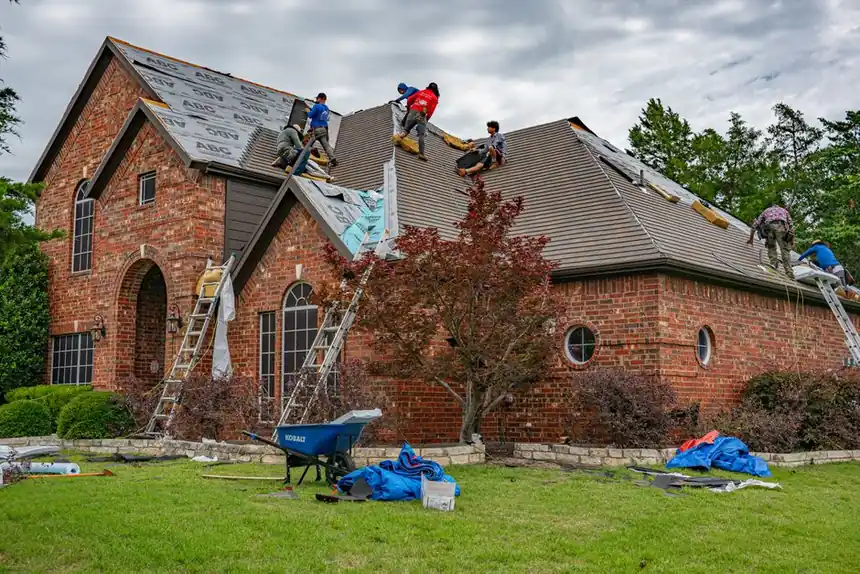
Metal roofing vs shingle roofing cost in Texas runs roughly $9 to $16 per square foot installed for metal and $4 to $7 per square foot for asphalt shingle, which means a 2,000-square-foot roof lands near $18,000-$32,000 for metal and $8,000-$14,000 for shingle in 2026. Metal costs about two to two-and-a-half times more upfront. Whether that gap is worth it depends on how long you plan to stay, how much hail your neighborhood takes, and how your insurer prices the roof.
We install both materials across the Houston and Dallas metros every week, and the honest answer is that shingle still wins on pure sticker price while metal wins on the 30-year math. Below we break down real 2026 numbers, lifespan, hail performance, and the questions that actually decide the call.
Metal vs Shingle Roofing Cost in Texas: The Short Answer
Metal roofing vs shingle roofing cost in Texas is a comparison of two very different price curves: shingle is cheap to buy and expensive to replace often, while metal is expensive to buy and cheap to own for decades. A standard 30-year architectural shingle roof costs $4 to $7 per square foot installed, and a standing-seam or corrugated metal roof costs $9 to $16 per square foot installed.
On a typical 2,000-square-foot single-story Texas home, that is $8,000-$14,000 for shingle against $18,000-$32,000 for metal. The gap narrows when you price in replacement cycles: a shingle roof lasts 15-20 years in Texas sun and hail, while a metal roof lasts 40-70 years.
If you are weighing a full system rather than a patch, our team handles both under one roof, so you can compare quotes side by side instead of guessing. Most homeowners start by looking at Roofing in Texas options and then narrow to a material.
What Metal Roofing Costs in Texas in 2026
Metal roofing cost Texas homeowners pay in 2026 ranges from $9 to $16 per square foot installed, with most residential jobs landing between $11 and $14. The material type drives most of the spread.
- Corrugated exposed-fastener panels: $9-$12 per square foot installed. Popular on barns, shops, and budget-conscious homes.
- Standing seam (hidden fastener): $13-$16 per square foot installed. The premium choice for homes and the best hail performer.
- Stone-coated steel: $12-$15 per square foot installed. Looks like tile or shake without the weight.
Add-ons move the number. Tear-off of an existing roof adds $1.50-$3 per square foot. A steep 10/12 pitch or a two-story home adds 15-25%. New underlayment, ice-and-water shield at valleys, and upgraded trim easily add $1,500-$4,000 on a 2,000-square-foot roof.
Metal is also the material we recommend most often for hail-prone corridors, and our Metal Roofing in Texas crews install both standing seam and stone-coated systems with manufacturer-backed warranties.
What Asphalt Shingle Roofing Costs in Texas in 2026
Asphalt shingle roof cost Texas homeowners see in 2026 is $4 to $7 per square foot installed, or roughly $8,000-$14,000 for a 2,000-square-foot roof. That is the number most insurance adjusters and real estate agents use when they talk about a "standard" roof.
Three grades dominate the market:
- 3-tab shingles: $4-$5 per square foot installed. 12-15 year life in Texas. Rarely worth it here.
- Architectural (dimensional) shingles: $5-$7 per square foot installed. 15-20 year life in Texas heat. The default choice.
- Premium/luxury shingles: $7-$10 per square foot installed. 20-25 year life. Heavier, better wind ratings.
Shingle roof replacement cost in Texas climbs fast when there is decking damage. Rotted or delaminated sheathing runs $60-$90 per sheet to replace, and we find at least a few sheets on most roofs over 20 years old. Hail claims often cover the shingle but not the decking, which is why the out-of-pocket number can surprise people.
Is Metal Roofing Cheaper Than Shingles in Texas?
No - metal roofing is not cheaper than shingles in Texas on day one, and any contractor who tells you otherwise is quoting you a shingle roof with a metal-sounding name. Metal costs two to two-and-a-half times more upfront. The question is whether it is cheaper over 30 years.
Run the math on a 2,000-square-foot roof:
- Shingle at $11,000 installed, replaced once at year 18 for $13,000 (inflation), total $24,000 over 30 years.
- Metal at $26,000 installed, still going at year 30, total $26,000.
That is close to a wash - and it tilts toward metal the moment you factor in hail. A metal roof that survives two hail events a shingle roof would not is worth thousands in deductibles and disruption alone. If you are staying in the home past 12-15 years, metal usually wins. If you are selling in five years, shingle usually wins.
Which Lasts Longer in Texas, Metal or Shingle?
Metal outlasts shingle in Texas by a wide margin: 40-70 years for a quality metal roof against 15-20 years for architectural asphalt shingles in our climate. The gap is driven by UV intensity, not by the material being "better" in some abstract sense.
Texas sits under some of the harshest sun in the country. Shingle granules - the part that blocks UV - erode at roughly 2-4% per year here, faster than the national average. Once the asphalt underneath is exposed, the shingle curls, cracks, and starts shedding. Metal does not care about UV. It fades slightly over decades and that is it.
Hail is the other variable. A 1.5-inch hailstone will bruise and knock granules off a shingle roof. The same stone usually dents or bounces off a 24-gauge standing seam panel. That is why so many Texas homeowners in hail corridors - including the ones we serve with Roofing in North Houston - eventually move to metal after their second or third shingle claim.
How Texas Heat, Hail, and Humidity Change the Math
Texas roof cost comparison is not the same as a national one because three local forces push shingle costs up and metal costs down over time.
Heat. Attic temperatures in a Houston or Dallas summer routinely hit 140-150°F. That cooks shingle from below as well as above, and it is why we see 15-year-old shingle roofs here that look like 25-year-old roofs in the Midwest.
Hail. The I-35 corridor and the Houston suburbs get hammered. A single 2-inch hail event can total a shingle roof. Metal panels rated to UL 2218 Class 4 often come through with cosmetic dents at worst - and many Texas insurers now discount premiums 10-25% for Class 4 impact-rated roofs.
Humidity and wind. Gulf humidity accelerates rust on cheap fasteners and thin panels. We specify galvanized or stainless fasteners and 24-gauge minimum steel for coastal-influenced areas. Wind uplift matters too - a properly fastened metal roof handles 140 mph, while standard 3-tab shingles are rated to 60-70 mph.
If you are in a neighborhood with a strict HOA, check the architectural rules before you commit. Some master-planned communities restrict metal to certain profiles or colors.
Does Metal Roofing Save Energy in Texas?
Yes, metal roofing saves energy in Texas - typically 10-25% on cooling costs when you choose a reflective "cool roof" finish over a dark shingle roof. The mechanism is simple: a light-colored or specially coated metal panel reflects solar radiation instead of absorbing it, so your attic stays cooler and your AC runs less.
Real numbers from Texas homes we have worked on: a 2,000-square-foot house with a dark architectural shingle roof and R-30 attic insulation often sees a $40-$70 monthly summer cooling bill drop after switching to a white or light-stone metal roof with a solar reflectance index (SRI) above 78. Over a 20-year horizon that is $6,000-$12,000 in avoided electricity - meaningful, but not enough on its own to justify metal.
Two caveats. First, the savings only show up if your attic is already reasonably insulated. A metal roof over a leaky attic is a shiny bandage. Second, dark metal colors absorb heat like shingle, so pick a light finish if energy savings are the goal.
Common Mistakes We See on Texas Roof Quotes
The biggest mistake Texas homeowners make is comparing a metal quote with full tear-off against a shingle quote that quietly reuses the existing underlayment. That is not a fair fight, and it is not what you want on your house.
Other traps we see regularly:
- Quotes without decking allowances. If the bid does not state a per-sheet price for rotted sheathing, expect a change order.
- Ignoring ventilation. A metal roof over an under-ventilated attic traps heat and shortens the roof's life. Ridge vents and intake vents are not optional in Texas.
- Cheap fasteners on metal. Galvanized screws cost a few cents more than painted steel. The painted ones rust through in 10-12 years on the Gulf Coast.
- No manufacturer warranty registration. Most metal and premium shingle warranties require the installer to register the job. If nobody does, you have a paper warranty with no teeth.
- Skipping the pre-installation inspection. A Roof Inspection in Texas before you sign catches soft decking, bad flashing, and prior repairs that change the scope.
When to Call a Professional
Call a roofer when you see granules piling up in gutters, curling or missing shingles, daylight through the attic deck, or a ceiling stain after a storm. Those are the signals that the roof is past patching and into replacement territory.
We handle both sides of this decision every day - shingle replacements for homeowners who want the lowest upfront cost, and metal installs for those staying long-term. If you are in the Dallas-Fort Worth area and want a straight comparison, our Roofing in Dallas team will walk the roof, measure it, and give you both numbers in writing before you decide. No pressure either way.
Frequently Asked Questions
Is metal roofing worth it in Texas?
Yes, if you plan to stay 12-15 years or more. Metal costs $9-$16 per square foot installed versus $4-$7 for shingle, but it lasts 40-70 years against 15-20 and often survives hail that totals a shingle roof. Shorter ownership windows favor shingle.
How much more does metal roofing cost than shingles in Texas?
About two to two-and-a-half times more upfront. On a 2,000-square-foot roof, expect $18,000-$32,000 for metal versus $8,000-$14,000 for architectural shingle in 2026. The gap narrows over 30 years once you account for one shingle replacement.
Which roof lasts longer in Texas, metal or shingle?
Metal, by a wide margin. Quality metal roofs last 40-70 years in Texas, while architectural asphalt shingles last 15-20 years because UV and heat break down the granules faster here than in most of the country.
Does metal roofing save energy in Texas?
Yes - 10-25% on summer cooling costs with a reflective finish. A light-colored metal roof with an SRI above 78 can cut $40-$70 per month off a typical Texas summer electric bill, but only if the attic is already well insulated.
Is metal roofing cheaper than shingles in Texas?
Not on day one. Metal is roughly double the upfront cost. It becomes cheaper over a 30-year horizon once you factor in one full shingle replacement and the hail claims metal tends to avoid.
Get Help With Roofing in Texas
Whether you land on shingle or metal, the right answer depends on your roof, your hail exposure, and how long you plan to own the home. We will measure it, price both options, and let you decide without a sales pitch.
Call Local Roofing Texas at (888) 842-0089 to schedule a free roof evaluation and get 2026 pricing for your address.