Full Tear-Off and Disposal
We remove every layer of old roofing down to the deck, load it into a dumpster on site, and haul it off the same day the job finishes. No dumpster sitting in your driveway for a week, no debris left in the flower beds.
Every full install covers the complete roof system, not just the visible surface. Here is what is standard on our scopes, and what we quote separately when your roof needs it.
We remove every layer of old roofing down to the deck, load it into a dumpster on site, and haul it off the same day the job finishes. No dumpster sitting in your driveway for a week, no debris left in the flower beds.
Every board gets checked for rot, delamination, and nail pop. Soft sheathing is replaced and photographed before we cover it. You get the photos in your final packet, which matters at resale and at claim time.
Synthetic underlayment goes over the full deck, with ice-and-water membrane in valleys, around chimneys, and at every penetration. New drip edge and step flashing are standard, not an upsell. This is where most leaks start when it is skipped.
We match intake and exhaust to the attic volume, installing ridge vents or off-ridge vents as needed. A balanced system drops attic temps and stops the premature shingle aging that cooks roofs from underneath in a Texas summer.
We pull the roofing permit, schedule the city inspection, and hand you the signed sign-off. Coastal jobs also get Texas Department of Insurance wind-uplift documentation filed with the municipality.
We register the manufacturer warranty in your name, including the enhanced coverage available through GAF Master Elite and Owens Corning Preferred programs, and email the certificate within 48 hours of completion.
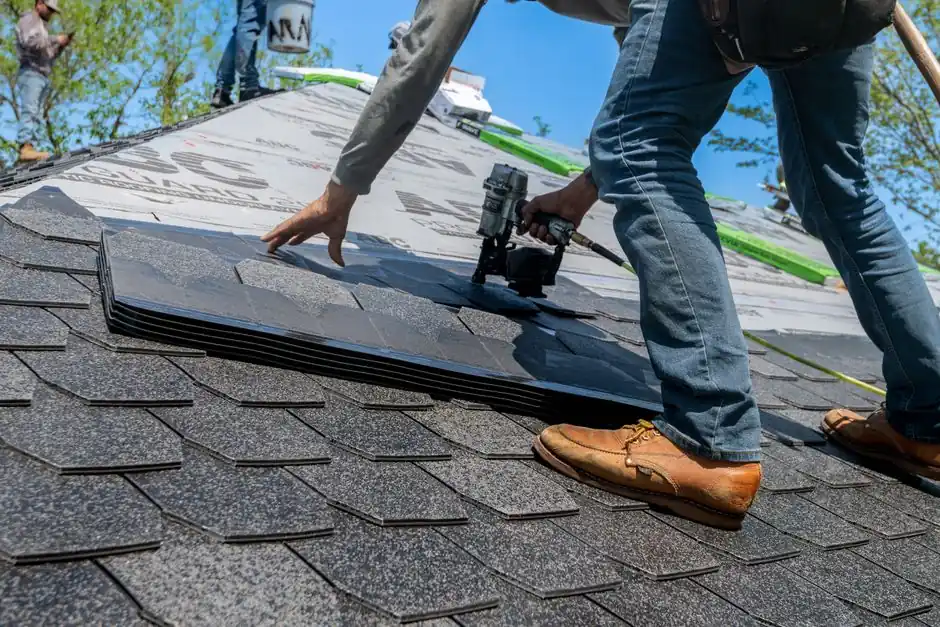
Roof Installation in Texas is the full tear-off and replacement of your roof system, not just the shingles. We strip the old material down to the deck, inspect and replace rotten sheathing, then build back up: underlayment, flashing, drip edge, ridge vents, and the finished surface. On a typical 2,000-square-foot ranch home that means 25 to 35 squares of material, 12 to 18 bundles of shingles, and a crew of six to eight working two to three days. We use roofing nail guns set to the manufacturer's depth, chalk lines for course alignment, and a moisture meter on any decking that looks suspect.
Texas roofs take a beating that roofs in milder states never see. Hail season runs March through June across the Dallas-Fort Worth and Austin corridors, and a single storm can total a 12-year-old shingle roof in 20 minutes. Along the Gulf, from Galveston to Sabine Pass, wind uplift ratings and salt air drive material choice. If you have been putting off a new roof installation Texas homeowners keep deferring, you are one storm away from a tarp and an insurance claim. Call (888) 842-0089 and we will tell you straight whether you need a full install or a repair.
Five steps, no mystery. You know who is on your roof, what they are doing, and when they will be gone.
Schedule
Call or book online — a real human picks up and confirms a 2-hour arrival window.
Diagnose
Licensed tech inspects on-site, then walks you through the cause and your options.
Fix
The job is completed to code and done right the first time — no shortcuts, no surprises.
Guarantee
Every job backed by a written workmanship warranty — and we stand behind it.
 Tools & Equipment
Roofing nail gun
Drives shingle nails to the manufacturer's specified depth and pattern. Set wrong, it voids the warranty; set right, it holds through 110-mph wind uplift.
Moisture meter and infrared camera
Finds hidden deck rot and active leaks without tearing open a good roof. We use both on every inspection and repair call before recommending a scope.
Chalk line and shingle cutter
Keeps course lines straight across long slopes and cuts clean edges at hips and valleys. Straight lines are not cosmetic; they are how the roof sheds water correctly.
Safety harness and roofing ladder
OSHA-compliant fall protection on every pitch, every day. We do not send anyone on a roof without it, and we do not cut corners on steep-slope jobs.
Pry bar and tarp
Pry bars strip old flashing and shingles without damaging the deck. Tarps protect landscaping during tear-off and cover open decking if weather turns mid-job.
NRCA installation standards
We follow National Roofing Contractors Association detailing for flashing, valleys, and penetrations. These are the standards manufacturers reference when they evaluate a warranty claim, so building to them protects your coverage.
GAF Master Elite and Owens Corning Preferred programs
These factory-certified programs require licensed, insured installers with a verified track record. They unlock the strongest material and workmanship warranties those brands offer, which we register in your name.
HAAG Certified inspection protocol
Our storm and hail evaluations follow the HAAG methodology adjusters recognize. That means consistent photo documentation, measured impact counts, and a report your carrier can act on without a second inspection.
Texas Department of Insurance wind-uplift compliance
Coastal and high-wind-zone installs are documented to TDI requirements, including fastening patterns and product approval numbers. We file the paperwork with the municipality so your certificate of compliance is on record.
01
What we do: We send a HAAG-trained inspector the same day, photograph every slope, and produce a damage report formatted for your insurance adjuster. If the damage warrants replacement, we handle the install and the paperwork.
→ You get a documented claim, an approved replacement, and a Class 4 roof that discounts next year's premium.
02
What we do: We inspect, give you a firm written scope, and install on a schedule that fits your closing date. The warranty certificate and permit sign-off go into the disclosure packet.
→ The deal closes on time, and the buyer inherits a registered manufacturer warranty instead of a question mark.
03
What we do: We stop patching and scope a full replacement, showing you the deck photos that explain why repairs keep failing. Material options are priced side by side so you can choose.
→ One install, one warranty, and no more calls to a roofer every time it rains.
04
What we do: We coordinate with your general contractor, order material to the site, and install to NRCA standards with the permit and wind-uplift documentation handled. Dry-in scheduling is available for framing-stage builds.
→ The roof is dried in on schedule, inspection passes the first time, and the warranty registers to the eventual homeowner.
Texas is not one climate, and we do not install one way. Along the Gulf from Galveston to Sabine Pass, salt air corrodes fasteners and wind uplift governs every fastening pattern, so we spec corrosion-resistant nails and document to Texas Department of Insurance standards. In the DFW corridor, hail drives the material choice: Class 4 impact-rated shingles from GAF, Owens Corning, or Malarkey are the default, and we photograph impact points for insurance claims after every spring storm. Central Texas, from Austin down to San Marcos, sits in a hail-and-heat band where attic ventilation matters as much as the shingle itself. West of Abilene, wind and UV age roofs faster than rain ever will. We stage crews out of multiple hubs so scheduling stays tight no matter where you are, and we buy from local suppliers who stock the material your region needs. If you are comparing roof installation in Texas cost between bids, ask each contractor what fastening pattern and underlayment they spec for your wind zone. The answer tells you whether they know your part of the state.
Alief
Older housing stock with original decking means we plan for sheathing replacement on most tear-offs here, and we price it into the scope up front.
Keller
Steep-pitch two-story homes common in Keller require extra fall protection and staging, which we build into the schedule rather than rush.
Seabrook
Coastal salt air drives fastener and flashing spec here. We use corrosion-resistant nails and file wind-uplift documentation with the city on every install.
Celina
New construction in Celina often means coordinating dry-in with the builder's framing schedule, which we handle directly with the general contractor.
Taylor
Hail bands hit Taylor hard in spring. We default to Class 4 impact-rated shingles and document impact points for insurance claims.
Spring hail season across North and Central Texas
March through June is peak claim season. We keep HAAG-trained inspectors on call so damage reports get written while the storm is still fresh in the adjuster's queue.
Gulf humidity and salt air
Coastal installs need corrosion-resistant fasteners, upgraded flashing, and wind-uplift documentation. We spec all three as standard, not add-ons.
Summer attic temperatures above 140 degrees
Ventilation balance is not optional here. We calculate intake-to-exhaust for your attic volume so shingles do not bake from underneath.
Winter ice and freeze-thaw in North Texas
Ice-and-water membrane in valleys and at penetrations prevents ice dam damage during the freeze events that hit the Panhandle and DFW.
Most Texas roofs fail from the same handful of causes. Catching them early is the difference between a repair and a full replacement.
Problem
Bruised shingle mat loses granules and cracks within two seasons, turning a covered claim into an out-of-pocket replacement.
Our Fix
Our HAAG-trained inspectors use roof-level photography to document impact points and produce an adjuster-ready report. We repair or replace the affected slopes and file the documentation with your carrier so the claim gets approved the first time.
Problem
Failed step flashing lets water into the deck and attic, causing rot, stained ceilings, and mold long before you see a drip.
Our Fix
We replace step flashing, counter-flashing, and pipe boots with new metal during every install, sealed with manufacturer-approved sealant. On repairs, we trace the entry point with a moisture meter and infrared camera instead of guessing.
Problem
Standing water breaks down TPO and modified bitumen seams, causing leaks that return every rainy season and shorten membrane life by years.
Our Fix
We install tapered insulation to build positive drainage into the deck before the membrane goes down. On existing flat roofs, we identify low spots with a moisture meter and correct the slope rather than patching over the symptom.
Problem
An unbalanced attic bakes shingles from underneath, ages them prematurely, and pushes summer cooling bills up 20 to 30 percent.
Our Fix
We calculate the intake-to-exhaust ratio for your attic volume and install ridge vents, soffit vents, or off-ridge vents to match. The result is a cooler attic, longer shingle life, and a lower electric bill every July.
A new roof is the one home upgrade that pays you back in insurance discounts, lower cooling bills, and a house that stays dry through the next hailstorm.
Insurance Premium Relief
Most Texas carriers discount premiums 10 to 25 percent for a documented new roof with Class 4 impact-rated shingles. We hand you the manufacturer's installation certificate and the permit paperwork so your agent can apply the credit the same week the job closes.
Hail and Wind Protection
Class 4 shingles from GAF, Owens Corning, and Malarkey carry a 2-inch steel-ball impact rating, the highest UL 2218 score available. In a Texas hail corridor that is the difference between a roof that survives a storm and one that feeds a claim.
Lower Cooling Costs
A properly vented ridge-and-soffit system with the right intake-to-exhaust ratio can drop attic temperatures 20 to 30 degrees in July. That translates to real money off your electric bill every summer, and it stops the premature shingle aging that bakes roofs from underneath.
Transferable Warranty Value
A GAF Master Elite or Owens Corning Preferred installation carries a 25- to 50-year material warranty plus a workmanship term you can hand to a buyer. When you sell, that paperwork is a negotiating asset, not a footnote.
Roof installation in Texas cost depends on square footage, pitch, material, and how many layers come off. Typical 2026 pricing for a full tear-off and install runs $9,500 to $24,000 for most single-family homes, with the state average near $14,500. We give you a firm written number after the inspection, not a phone estimate. If you want to compare roof installation services Texas wide, ask each bidder for square counts, underlayment spec, and the fastening pattern for your wind zone. Those three answers explain most of the price gap between quotes.
Typical Investment Range
$9,500 - $24,000 for most Texas single-family homes, depending on size, pitch, and material
A new roof is a 25- to 50-year asset that lowers insurance premiums, cuts summer cooling costs, and transfers to the next owner. We price the whole system, not just the shingles, so the number you approve is the number you pay.
What changes the price
Roof size and pitch
Square footage drives material and labor directly. Steep pitches above 8/12 slow the crew down and require extra fall protection, adding 15 to 30 percent to labor on those slopes.
Layers to remove
One layer of old shingles is standard. A second layer adds disposal weight and tear-off time, typically $1,000 to $2,500 depending on square count and dump fees.
Material choice
Architectural shingles sit at the low end, Class 4 impact-rated shingles add 10 to 20 percent, and standing-seam metal roofing panels can run two to three times the shingle price. Each carries a different warranty term.
Decking condition
Soft or delaminated sheathing gets replaced at a per-sheet price. We photograph every replaced panel so you see exactly what went into the scope and why.
Flashing and ventilation upgrades
New step flashing, drip edge, and ridge vents are standard on our scopes. Adding intake vents or upgrading to a balanced ventilation system is quoted separately with the numbers in front of you.
Access and staging
Tight lots, steep driveways, or landscaping that needs protection can add setup time. We walk the property during the inspection and price access honestly rather than surprising you mid-job.
Google ★★★★★4.9
They inspected on a Tuesday and had the new roof on by Friday. The crew chief walked me through the deck photos before they covered anything, which no other bidder offered. Yard was swept clean twice. Worth every dollar.
Yelp ★★★★★4.8
Hail claim had been denied once before I called them. Their inspector's photo report got it reopened and approved. Install was clean, and the warranty certificate showed up in my inbox two days later.
BBB ★★★★★4.9
We used them on a coastal rental with salt-air corrosion. They spec'd the right fasteners and filed the wind-uplift paperwork with the city without being asked. Two years, zero leaks, and the insurance discount covered the upgrade.
Our installers hold GAF Master Elite and Owens Corning Preferred credentials, and several carry HAAG Certified Inspector training for storm and hail evaluation. We work to NRCA installation standards and Texas Department of Insurance wind-uplift requirements on every job, whether it is a 900-square-foot garage in Keller or a 60-square retail roof in Houston. We have installed roofs through Gulf humidity, Panhandle wind, and Central Texas hail, and we know which material fails first in each region. That local experience is why our callbacks run below the industry average.
Our crews cover the state, from the Gulf Coast to the DFW suburbs and down through Central Texas. Wherever you are, you get the same scope, the same warranty registration, and the same same-day estimate that a new roof installation Texas homeowners can count on. Below are a few of the communities we serve most often.
Older housing stock in Alief means we plan for sheathing replacement on most tear-offs and price it into the written scope up front, so there are no mid-job surprises.
Austin sits in a hail-and-heat band where attic ventilation matters as much as the shingle. We spec Class 4 impact-rated shingles and balance intake-to-exhaust on every install.
Wellborn's mix of rural and newer residential roofs gets the same code-correct flashing and underlayment detailing we use statewide, with scheduling built around local weather windows.
Carrollton's mature subdivisions often have two layers of shingles to remove. We handle the extra tear-off and disposal in the same two- to three-day window.
Coastal salt air in Sabine Pass drives corrosion-resistant fasteners and wind-uplift documentation filed with the city. We spec both as standard on every install here.
Mansfield roofs take spring hail hard. Our HAAG-trained inspectors document impact points for insurance claims, then install Class 4 shingles rated for the next storm.
Wylie's newer two-story homes often have steep pitches that slow a crew down. We build the extra fall protection and staging time into the schedule instead of rushing the job.
Keller's steep-pitch homes get the same NRCA flashing and ventilation detailing on every slope, with photos of the deck before we cover anything.
Hurst's mid-century housing stock often needs decking repair alongside the new roof. We photograph every replaced panel and include it in your final warranty packet.
New construction in Celina means coordinating dry-in with the builder's framing schedule. We work directly with general contractors and file the permit and wind-uplift paperwork.
Alvin's mix of residential and agricultural buildings gets the right system for each: architectural shingles on homes, metal roofing panels on barns and outbuildings.
Anna sits in the North Texas hail corridor. We default to Class 4 impact-rated shingles and document storm damage for insurance claims after every spring event.
Crowley homeowners get same-day estimates and a firm written scope with square counts, material options, and a schedule that fits around North Texas weather.
Taylor's hail bands hit hard in spring. Our inspectors photograph impact points and produce adjuster-ready reports, then install shingles rated to survive the next round.
Seabrook's coastal location means salt air and wind-driven rain. We install corrosion-resistant fasteners and standing-seam metal roofing panels, with wind-uplift paperwork filed locally.
Real answers to the questions we hear most often from local homeowners and property managers.
When a repair will not hold, roof replacement is the next step. We strip to the deck, rebuild the system, and upgrade ventilation and flashing while we are up there. Most replacements include the same warranty registration as a new install.
View Roof ReplacementNot every problem needs a full install. Missing shingles, flashing failure, and small leaks get fixed in a single visit, usually within 48 hours of your call. We tell you honestly when a repair will buy you five more years and when it will not.
View Roof RepairWe trace leaks with a moisture meter and infrared camera instead of guessing, then seal the actual entry point. Most leak calls are resolved same-day. If the leak traces back to failed decking, we scope the repair and show you the photos.
View Roof Leak RepairA full inspection covers every slope, flashing point, and attic ventilation path, with photos and a written report. It is the right call before buying a home, after a hailstorm, or when you are not sure whether you have a problem.
View Roof InspectionStorm damage at 2 a.m. gets a tarp on the roof and a call back within the hour. We stabilize the structure, document the damage for your claim, and schedule the permanent repair as soon as weather allows.
View Emergency Roofing ServicesAfter a Texas storm, we document wind and impact damage in an adjuster-ready report, then handle the repair or replacement. We work directly with your insurance carrier so you are not translating between a roofer and an adjuster.
View Storm Damage Roof RepairCall (888) 842-0089 any hour for emergency tarping or to book a free inspection. Our office answers phones 24/7, and most non-emergency inspections are scheduled within 48 hours. You can also email [email protected] with photos of your roof and we will reply with a preliminary assessment.
Phone
(888) 842-0089Address
Texas
Hours
Mon–Fri: 7AM – 7PM
Sat: 8AM – 4PM
Sun: Emergency Only
24/7 Emergency Available